
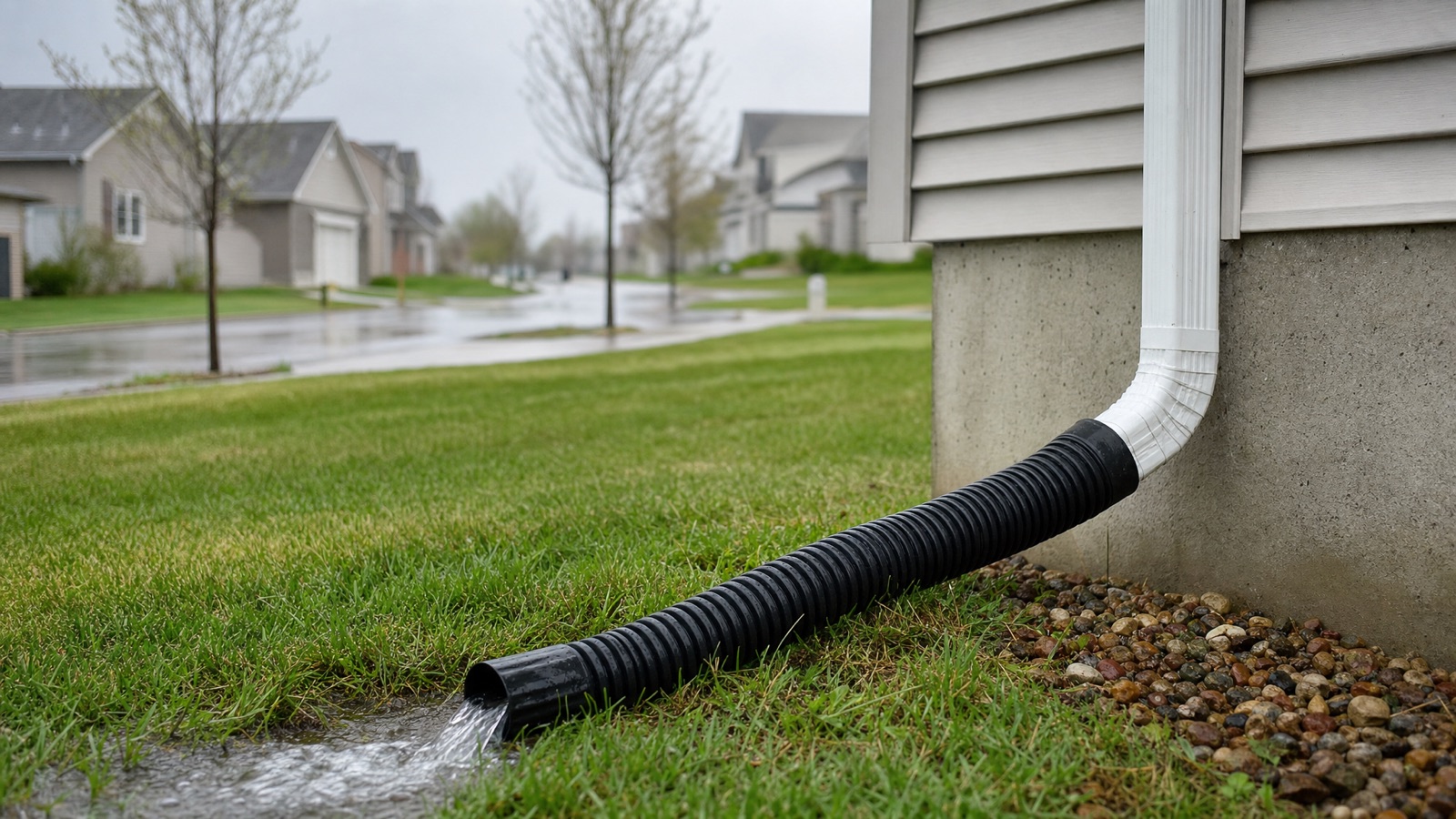
Most foundation water problems in the Twin Cities do not start with a mysterious underground spring. They start on the roof. Gutters and downspouts are the cheapest, least glamorous, and most under-maintained part of a home’s water management system, and when they fail, the water goes exactly where you do not want it: straight down along the foundation wall.
If you have a wet basement, a bowing block wall, or a crack that seems to weep after every heavy rain, the fix often starts twenty feet above your head.
The Math Most Homeowners Have Never Done
Rainfall on a roof adds up faster than people expect. One inch of rain produces roughly 0.62 gallons of water for every square foot of roof footprint.
Run that for a typical Woodbury or Oakdale house with a 1,500 square foot footprint:
- A single 1 inch rain puts about 935 gallons of water on that roof.
- Split across four downspouts, each one is discharging roughly 230 gallons.
- Over a full year, using the Twin Cities average of about 31.6 inches of precipitation from the 1991 to 2020 normals at MSP, that roof sheds close to 29,000 gallons.
That is not a drip. That is a small swimming pool, every year, and your gutters decide whether it lands ten feet out in the yard or six inches from your basement wall.
June is the wettest month in the metro, averaging around 4.58 inches, and June storms tend to arrive as heavy, fast downpours rather than gentle all-day rain. A gutter system that handles a slow drizzle can overflow completely in a fast one.
Why This Hits Minnesota Foundations Harder
Two local conditions turn ordinary roof runoff into a foundation problem.
The backfill zone
When your house was built, a hole was dug, the foundation was poured or laid up, and the excavated soil was pushed back in around it. That backfilled soil never returns to the density of the undisturbed ground around it. It stays looser and more porous, which means water preferentially sinks right there, in the ring of soil hugging your foundation.
Contractors call this the clay bowl effect, and it matters more here than in most of the country because the Twin Cities sit on heavy glacial till. Dense, clay-rich soil drains slowly, so water that soaks into the backfill does not keep moving down and away. It pools, and it presses. That lateral force is hydrostatic pressure, and it is the mechanism behind most bowing and cracked basement walls we repair.
Freeze and thaw
Saturated soil in October becomes frozen, expanded soil in January. Minnesota code requires footings at 42 inches in the southern part of the state precisely because the frost goes that deep. Soil that your downspouts kept wet all fall is soil that will expand hard against your foundation all winter, then collapse and settle again in spring. Repeat that for a decade and you get the stair-step cracks and inward movement that show up in block foundation repair calls every year.
Dry soil does far less of this. Controlling roof water is the single most cost-effective way to keep the soil around your foundation dry.
What a Working System Actually Looks Like
Gutters that are clear and pitched. Gutters need a slight fall toward the downspouts, roughly a quarter inch of drop for every 10 feet of run. Sagging sections hold standing water, get heavier, pull the hangers loose, and then overflow at the low point. That overflow lands in one concentrated spot against the house, which is the worst possible pattern.
Enough downspouts. A common shortfall is too few downspouts for the roof area. If one downspout is draining a long stretch of roof, it will back up and spill over during heavy rain no matter how clean the gutter is.
Extensions that clear the backfill. This is where most homes fail. A splash block moves water about 18 inches. The backfill zone extends out as far as the original excavation, often 4 feet or more. Get extensions out to at least 4 to 6 feet, and 6 to 10 feet if you have a basement or soil that drains poorly.
Discharge onto ground that slopes away. An extension that ends in a low spot just relocates the problem. Minnesota’s residential code calls for the grade to fall at least 6 inches within the first 10 feet from the foundation. If your yard does not do that, the extension is dumping water into a basin.
Buried drain lines where the yard fights you. On tight lots, or where a walkway or driveway blocks a run, a buried solid pipe carrying downspout water to a pop-up emitter well out in the lawn is a clean permanent solution.
Common Mistakes We See in the East Metro
- Downspouts tied directly into drain tile. This overwhelms the system your foundation depends on. Roof water and groundwater need separate paths.
- Extensions taken off for mowing and never put back. Extremely common, and the damage is invisible until it is not.
- Ice-clogged gutters treated as a roof issue only. Ice dams back water up under shingles, but they also mean melt water is sheeting off the roof edge and landing directly at the foundation all winter.
- New landscaping that reverses the grade. Fresh mulch and edging beds piled against the house are a frequent cause of newly wet basements in otherwise dry homes.
- Gutters fixed, grade ignored. Gutters and grading are one system. Perfect gutters over a yard that slopes toward the house will still put water in your basement.
That last one is why we treat this as corrective grading work rather than gutter work. Managing roof water and shaping the ground around the house are the same job.
When Gutters Are Not Enough
Sometimes the water management is genuinely correct and the basement is still wet. That usually means the water is arriving below grade rather than from above, and the answer moves to drain tile and a sump system or, if the wall has already moved, to structural foundation repair. Our post on why East Metro homes get wet basements walks through how to tell the difference.
The honest sequence is: fix the cheap things first, then measure what is left. Plenty of homeowners in Woodbury, Stillwater, and Cottage Grove have spent thousands on interior systems when three downspout extensions and a regraded flower bed would have solved it. Just as many have replaced gutters three times while a failed drain tile quietly kept the basement wet.
Get an Honest Read Before You Spend
Concrete & Foundation Solutions has been diagnosing water and foundation problems across the Twin Cities East Metro and St. Croix Valley for over 20 years. We will tell you if the answer is a hundred dollars of downspout extension, and we will tell you plainly if it is not.
Call 651-364-4400 or request a free inspection. We will look at your gutters, your grade, and your foundation together, because that is the only way the diagnosis is worth anything.
Related Services
Have a Foundation Concern?
Get a free, honest inspection from a local team with 20+ years of Twin Cities experience.
Call 651-364-4400