
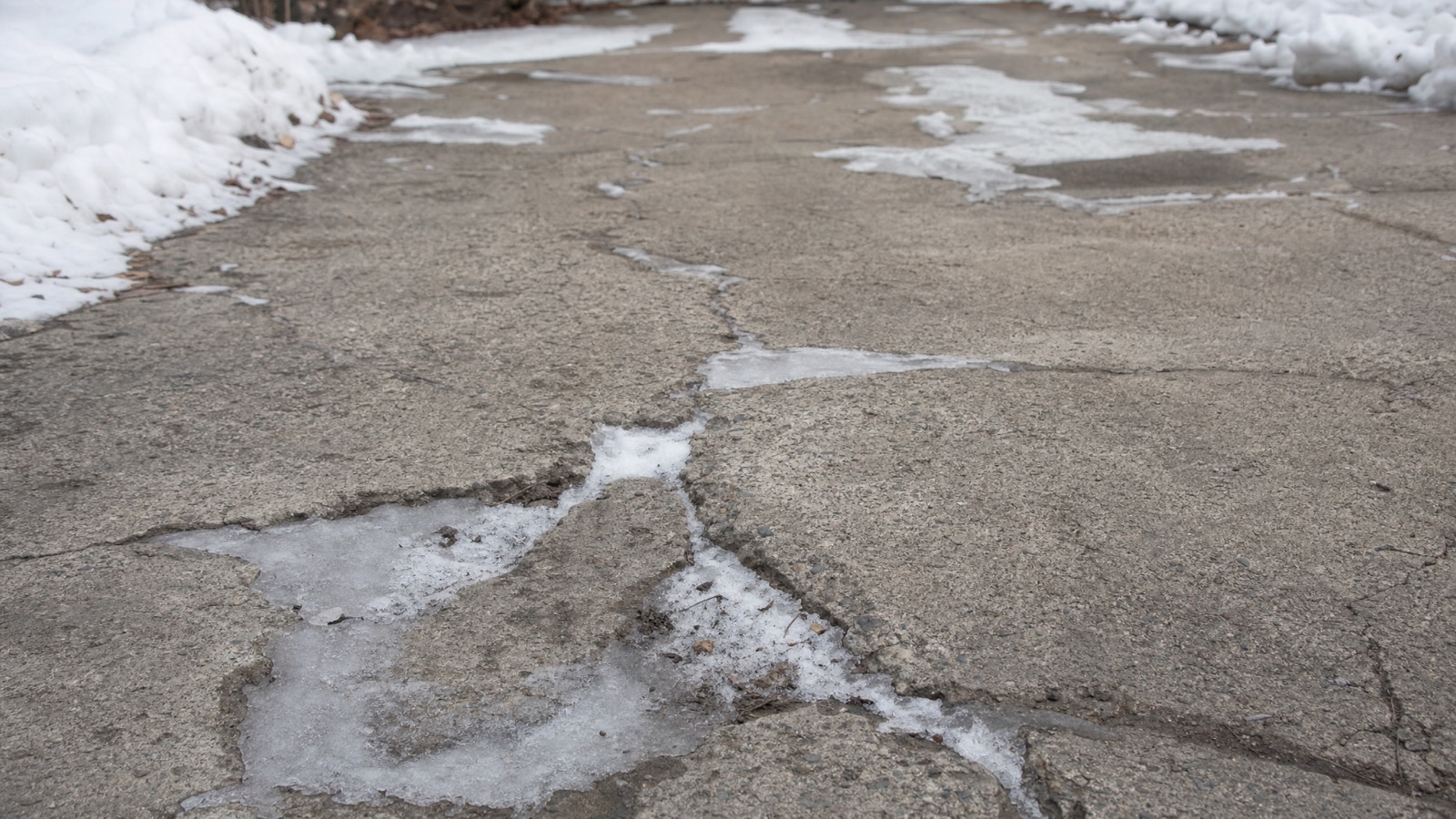
Minnesota puts concrete through some of the harshest conditions in the country. If you have watched a driveway or sidewalk go from smooth to crumbling in a handful of winters, you have seen freeze-thaw damage firsthand. Understanding why it happens, and what good installation practices prevent it, helps you make smarter decisions about new concrete work and maintenance on what you already have.
The Physics Behind the Problem
Water expands roughly nine percent when it freezes. That number does not sound dramatic until you think about what happens when water gets trapped inside concrete.
Concrete is not a solid, impermeable material. It contains a network of tiny pores and capillaries throughout its structure. When liquid water enters those voids and then freezes, the expansion creates internal pressure the concrete must absorb. One cycle alone may not cause visible damage. But concrete in the Twin Cities and the East Metro endures dozens of freeze-thaw transitions every winter, sometimes in a single week when temperatures swing from the teens up to the forties and back down again.
Each cycle adds stress. Over time, that stress causes the surface layer to flake off (called spalling), cracks to widen, and sections to shift or heave. Driveways, patios, sidewalks, and foundation walls all experience this, though the consequences vary by location and how much moisture is present.
Why Some Concrete Holds Up and Some Does Not
The difference between concrete that lasts thirty years and concrete that deteriorates in five comes down largely to how it was designed and installed. Three factors stand out.
Base Preparation
Concrete is only as stable as what sits underneath it. In Minnesota, proper base preparation means compacted, well-draining material (typically crushed aggregate at a consistent depth) beneath the slab. When the base is inadequate, moisture collects underneath the concrete and accelerates freeze-thaw movement. The slab can crack, heave, or settle unevenly as the ground beneath it shifts with the seasons.
Control Joints
Control joints are the intentional cuts or grooves placed in a concrete slab at regular intervals. Their purpose is to give the slab a predictable place to crack as it expands and contracts, rather than cracking randomly. Without properly placed and spaced control joints, stress concentrates in unpredictable spots and produces the kind of irregular cracking that is difficult and expensive to repair. Good installation accounts for slab size, thickness, and intended load when spacing joints.
Air-Entrained Concrete Mix
This is arguably the most important material decision for concrete placed in a freeze-thaw climate. Air-entrained concrete contains billions of microscopic air bubbles distributed throughout the mix. When water inside the concrete freezes and expands, those air pockets provide relief space for the pressure. Without that buffer, the freezing water has nowhere to go except outward, which means damage to the concrete itself.
For exterior flatwork in Minnesota (driveways, patios, sidewalks, steps), air-entrained mixes are the standard expectation, not a premium upgrade. If you are getting bids on new concrete work, it is worth asking whether the mix specification includes air entrainment.
Surfaces Most Affected in the East Metro
All exterior concrete faces freeze-thaw stress, but a few types are particularly vulnerable.
Driveways take a compounding hit. They carry vehicle loads, absorb road salt (which accelerates surface deterioration even in air-entrained mixes), and collect runoff from the house, garage, and street. Heavy deicers, particularly those containing ammonium nitrate or ammonium sulfate, are especially damaging and should be avoided entirely on concrete surfaces.
Patios and sidewalks see less load stress but are often installed at thinner depths, which makes them more susceptible to settling and cracking when the base moves.
Foundation walls and slabs deal with a different version of the problem. Water that pools against a foundation and repeatedly freezes and thaws can widen existing cracks, push against walls, and eventually compromise structural integrity. This is why proper grading and drainage around a home is part of foundation health, not just landscaping.
Year-Round Protection Strategies
Protecting concrete in Minnesota is not a one-time task. A few consistent practices make a real difference.
- Seal regularly. A quality concrete sealer reduces water infiltration significantly. Plan to reseal every two to three years depending on traffic and exposure.
- Choose deicers carefully. Plain sand for traction, or magnesium chloride if you need a deicer, are much less damaging than rock salt or chemical blends. Avoid ammonium-based products entirely.
- Manage drainage. Water that pools on or near concrete accelerates damage. Keep gutters clear, extend downspouts away from slabs and foundations, and make sure the grade around your home directs water away from the structure.
- Address cracks early. Small cracks that get water in them become bigger cracks after a winter. Filling and sealing minor damage before the freeze season buys time and slows the progression.
When to Call for an Evaluation
If you are seeing widespread spalling across a driveway or patio, cracks wider than a quarter inch, sections that have shifted vertically relative to each other, or any deterioration near your foundation, it is worth having a professional look at what is happening below the surface. Surface repairs on top of a compromised base will not hold.
Our team has worked on concrete and foundations across Woodbury and the broader East Metro and St. Croix Valley for over 20 years. We can assess whether a surface repair, foundation resurfacing, or more involved foundation repair is the right approach for what you are dealing with.
We offer free estimates. If you have questions about your driveway, patio, sidewalk, or foundation going into another Minnesota winter, call us at 651-364-4400 or contact us online. You can also learn more about our full range of concrete services if you are planning new work.
Winter here is not kind to poorly installed or unmaintained concrete. But with the right materials, proper installation, and reasonable maintenance, concrete placed in this climate can hold up for decades.
Related Services
Have a Foundation Concern?
Get a free, honest inspection from a local team with 20+ years of Twin Cities experience.
Call 651-364-4400