
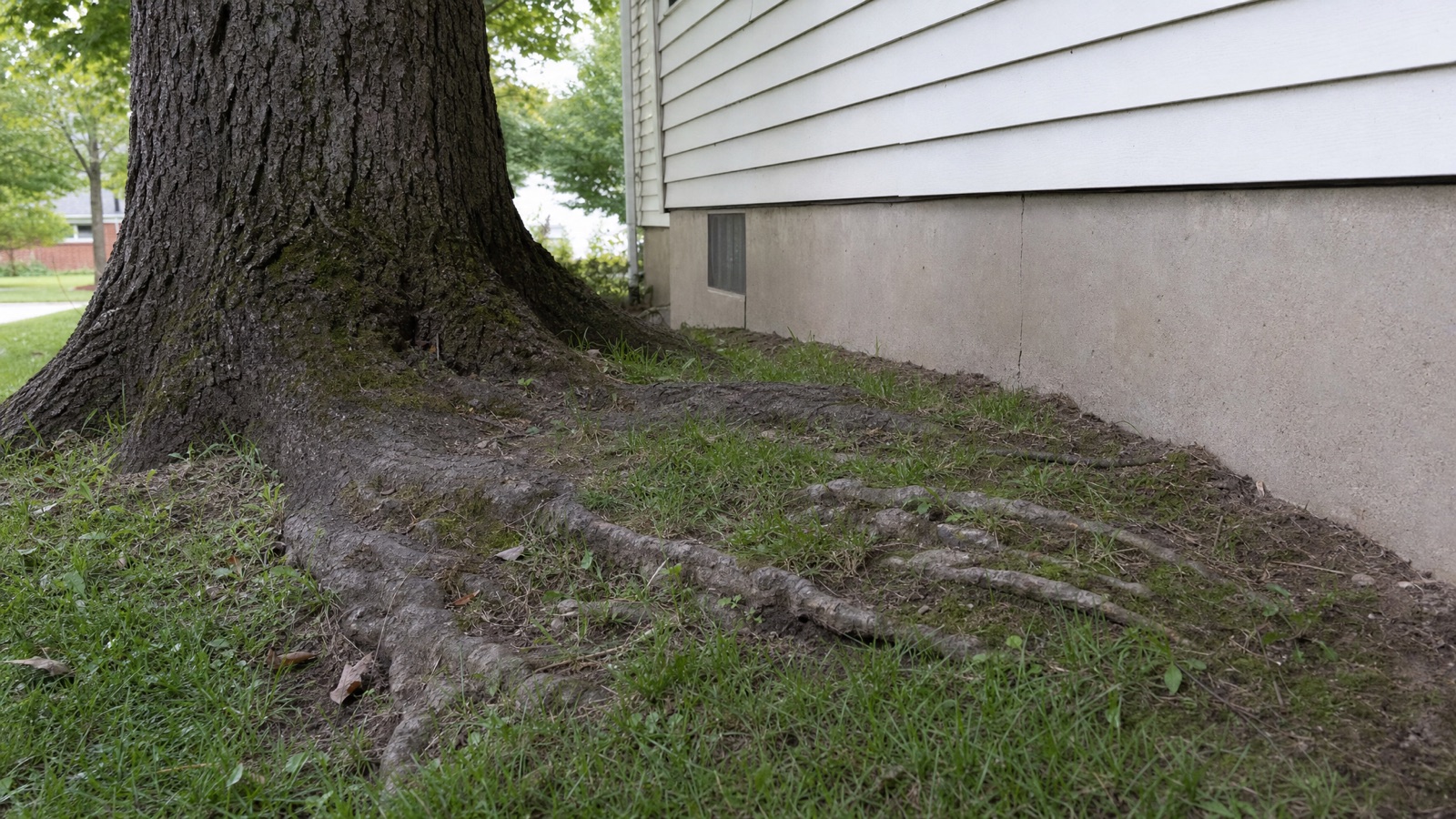
Almost every established neighborhood in the East Metro has them: big silver maples and oaks that were saplings when the house went up, now taller than the roofline and standing 10 or 15 feet off the foundation. When a crack shows up in the basement wall on that side of the house, the tree is the obvious suspect.
It usually is involved, but not in the way most homeowners assume, and that distinction matters because the obvious fix can make things worse.
The Root Pressure Myth
The common picture is a root growing into a foundation wall and levering it apart. That is not really what happens.
Roots grow where there is oxygen, water, and low resistance. A sound poured concrete or block wall offers none of those, so a root that meets one turns and grows along it. What roots will do is:
- Widen a crack that already exists. Once a hairline crack gives a root a foothold with moisture behind it, the root thickens over years and pries the opening wider.
- Lift flatwork. Sidewalks, patios, and driveway slabs sit on a few inches of base, not on a 42 inch footing. Surface roots heave those easily, and that is the root damage most people actually see.
- Get into pipes. Clay tile pipe went into Twin Cities yards well into the 1980s, in short sections with a joint every few feet, and freeze-thaw cycles work those joints loose. Once a gap weeps moisture, roots follow it in and expand until the pipe cracks.
So roots do cause damage. But the damage showing up in your basement wall is usually coming from somewhere else.
The Real Mechanism: Roots Drink, Clay Shrinks
The soils under most of the metro are glacial till, the unsorted mix of clay, silt, sand, and gravel the ice sheet left behind. The clay fraction is what matters. Clay changes volume with moisture, swelling when it takes on water and shrinking when it dries. That is the same mechanism behind most of the wet basement and wall movement problems in the East Metro.
A mature tree is a very effective pump. Its feeder roots, most of which sit in the top 12 to 18 inches of soil, pull water continuously through the growing season. When that happens on one side of a house, the clay under that side of the footing dries and contracts while the soil on the shaded or downspout-fed side stays damp.
That is differential settlement: one part of the foundation drops relative to another. It produces diagonal cracks running off window and door corners, doors that stick in one room and not another, and a wall that is out of level end to end. It is slow, measured in years rather than seasons, which is why it usually gets noticed only after something else tips the balance.
Why Drought Years Show Up in Basements
Minnesota’s recent dry stretches are exactly that tipping point. The 2021 drought was the most severe the state had seen in decades, and 2023 pulled most of Minnesota back into drought. During the worst of it, Twin Cities surface soils were reported at fractions of a percent moisture content, and you had to go two to three feet down to find adequately moist soil.
Now add a mature tree. It does not stop drinking during a drought, it roots deeper and works harder. Clay that is already moisture-starved gets pulled further below its shrinkage limit, and the soil supporting that side of the footing loses volume.
Cracks that appear in a Woodbury or Maplewood basement the year after a hard drought are frequently this, a tree and a dry summer working together. The next spring the clay rehydrates and swells partway back, and the cycling begins. Which is why a crack that opens and closes with the seasons is telling you something different than one that only ever gets wider.
Which Trees Cause the Most Trouble
Species matters mostly as a proxy for water demand and root spread. The high-risk list for Minnesota yards:
- Silver maple. Extremely common in older Twin Cities yards. Fast growing and shallow rooting, with roots that spread well past the canopy edge.
- Willow. The thirstiest common landscape tree. Keep it 50 feet off the house and away from any sewer line.
- Cottonwood and poplar. Aggressive, water-seeking, and fast. Common along the St. Croix and on older rural lots.
- Elm and ash. Wide, vigorous root systems, and many East Metro yards still carry legacy specimens from the boulevard planting era.
Lower-risk choices include ironwood, serviceberry, hackberry, and most ornamental crabapples. Mature size is the real variable: a tree that tops out at 25 feet is a very different neighbor than one reaching 70.
How to Tell if the Tree Is Actually the Problem
Before anyone touches the tree, work through this:
- Where is the damage relative to the tree? Root-driven settlement concentrates on the side nearest the canopy. If the worst cracking is on the opposite corner, look elsewhere.
- What is the drainage doing? A downspout dumping at the foundation or a yard sloping back toward the house causes far more movement than any tree, and it is much cheaper to fix. Corrective grading is where we start on a majority of the calls we take.
- Is the crack diagonal or horizontal? Diagonal cracks off opening corners point to settlement. A horizontal crack with inward bowing is lateral soil pressure, a different problem with different repairs.
- Is it moving? Mark the ends of the crack with a pencil, date it, and measure the width. Six months of data tells you more than any single look.
What Not to Do
The instinct after a crack appears near a big tree is to cut it down immediately. Slow down. A tree that has been drying the soil under one side of a house for 40 years has established a moisture equilibrium. Remove it suddenly and that clay rehydrates and swells, and the foundation can heave upward, which is sometimes worse than the settlement you were trying to stop. If removal really is the right call, pair it with a plan for the foundation. And skip the chemical root killers, which do nothing about soil moisture.
Fixing It Properly
Once we know what is driving the movement, the repair path is usually one of these:
- Correct the water first. Extend downspouts well past the foundation, restore positive slope, and repair failed drain tile so the soil around the footing stays consistent instead of swinging between soaked and bone dry.
- Stabilize the foundation. Where a footing has genuinely settled, foundation repair with piering transfers the load down to stable soil and takes the tree, the drought, and the clay out of the equation permanently.
- Seal and monitor. Stable, non-structural cracks get sealed and watched rather than over-repaired.
- Manage the tree instead of removing it. Root barriers between the tree and the foundation, deep watering during dry spells, and mulch to slow evaporation reduce the moisture swing without losing a 60 year old canopy.
Consistency is the theme. Clay does not mind being wet and does not mind being dry. What it minds is going back and forth.
Get a Straight Answer Before You Cut Anything
A big tree near the house is not automatically a problem, and a crack near a big tree is not automatically the tree’s fault. Sorting out which one you have takes an inspection, not a guess.
We have been doing this in Woodbury, Stillwater, Cottage Grove, Oakdale, and across the East Metro and St. Croix Valley for over 20 years. The inspection is free, and if your tree is fine and your downspouts are the real problem, we will tell you that.
Call 651-364-4400 or reach out through our contact page to schedule your free foundation inspection.
Related Services
Have a Foundation Concern?
Get a free, honest inspection from a local team with 20+ years of Twin Cities experience.
Call 651-364-4400