
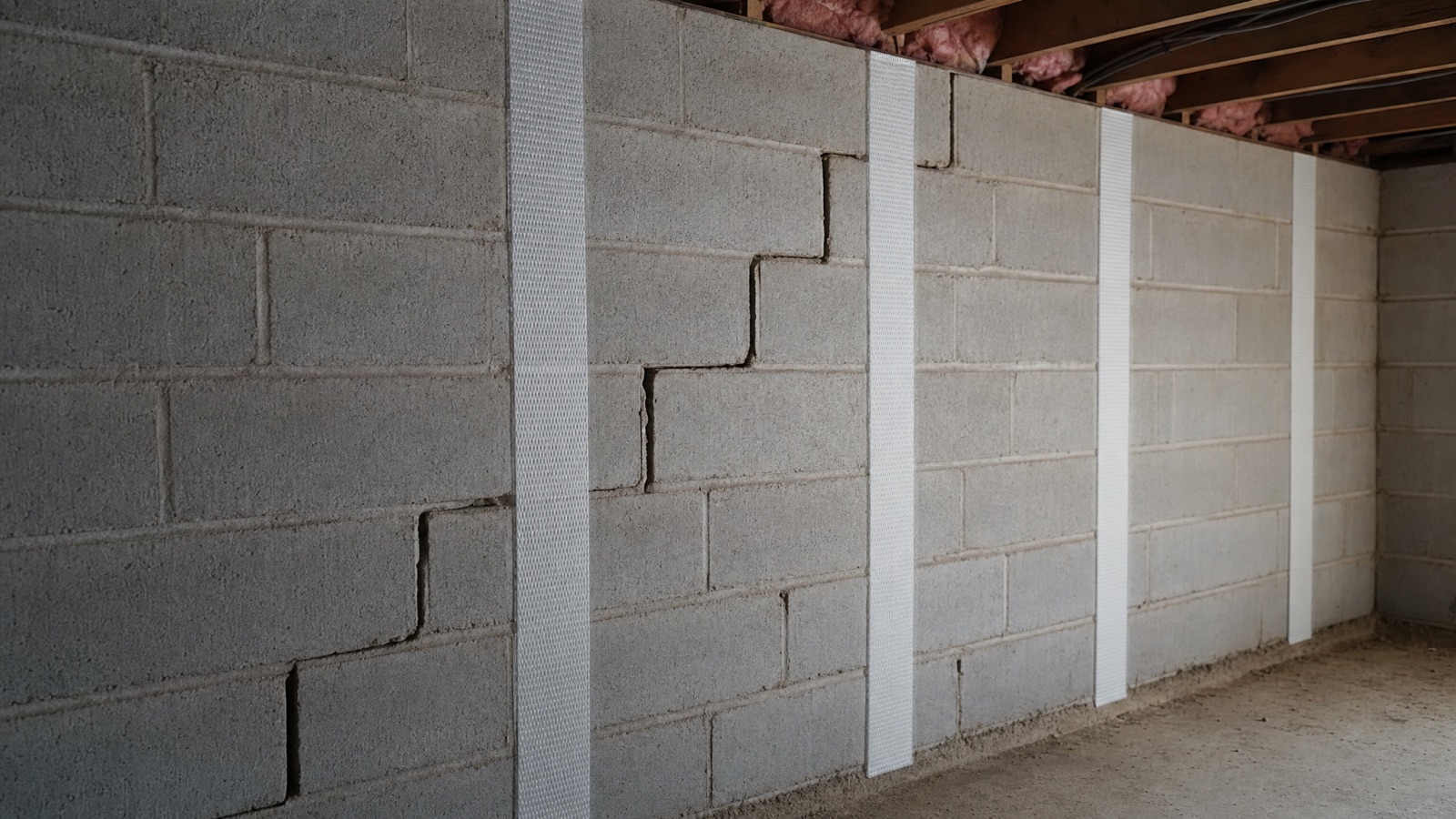
Many Twin Cities homeowners discover during a home inspection or a wet basement investigation that their foundation is made of concrete block rather than poured concrete. If your home was built between roughly 1950 and 1985, there is a good chance this describes you. The inner-ring suburbs that built out rapidly after World War II, including Maplewood, Oakdale, White Bear Lake, and parts of Woodbury itself, are full of concrete block foundations. Understanding how these walls behave, what goes wrong over time, and which repairs actually solve the problem can save you from expensive surprises.
Why So Many Homes Have Block Foundations
Concrete masonry unit (CMU) construction dominated residential building in Minnesota for several decades. Block was fast to lay, locally available, and contractors knew the system well. The blocks themselves are strong in compression, meaning they handle the weight of the house without trouble. The weakness is in lateral resistance, the ability to resist sideways force from soil pressing against the outside of the wall.
Poured concrete walls form a single monolithic structure. Block walls are stacked units bonded with mortar, which creates a wall that has natural joints throughout. Those joints are the first place stress concentrates when the wall is under pressure.
How Block Foundations Fail
Minnesota’s soil and climate create a particularly demanding environment for below-grade walls. Clay-heavy soils throughout the metro absorb water, expand, and press against the foundation during wet periods. Winter freeze-thaw cycles add to this. Frost in the soil can generate enormous lateral force against the upper portions of a block wall.
The most common failure patterns are:
- Stair-step cracking. Cracks that run diagonally along the mortar joints, often starting at a corner and stepping downward. This usually indicates differential settlement or corner movement.
- Horizontal cracking. A crack running along a single mortar joint, typically near mid-height of the wall. This is a serious sign of lateral soil pressure and warrants immediate attention.
- Inward bowing. The wall curves inward, with the greatest deflection usually at the midpoint between floor and rim joist. Bowing that has progressed beyond a small amount significantly narrows your repair options.
- Mortar joint deterioration. Older mortar can soften, crumble, or wash out over time, allowing water to penetrate and the structural bond between blocks to weaken.
The combination of heavy clay soils, high groundwater in parts of the East Metro, and repeated freeze-thaw cycles makes this a common issue in the region, not an unusual one.
Repair Methods Compared
There is no single right answer for block foundation repair. The correct method depends on how much the wall has moved, the soil and drainage conditions outside, the age of the blocks and mortar, and your plans for the property. Here is how the main options differ.
Carbon Fiber Straps
Carbon fiber straps are bonded vertically to the interior face of the block wall, anchored at the top plate and the floor slab. They are strong in tension and prevent the wall from moving further inward. This is often the right choice when bowing is in an early stage and the goal is to stop further movement without excavating.
Best for: Walls with minor to moderate inward deflection, good existing block condition, and limited budget for exterior excavation.
Not ideal for: Walls that have already moved significantly or where the blocks themselves are deteriorating.
Steel I-Beams and Wall Anchors
Steel I-beams installed floor-to-ceiling against the interior of the wall provide rigid bracing. Wall anchors are a related system where steel plates are driven into stable soil outside the pressure zone and connected through the wall to interior plates. Wall anchors offer the possibility of gradual re-tightening over time to slowly straighten the wall.
Best for: More advanced bowing, situations where some degree of correction is desired, or where future adjustability is valuable.
Trade-off: I-beams take up several inches of interior space along the wall. Wall anchor installation requires drilling through the wall and driving anchors outward into the yard.
Core Filling
Hollow-core concrete blocks can be filled with grout or concrete to add mass and rigidity to the wall. This is sometimes done in combination with other repairs to strengthen a wall that is structurally intact but needs more resistance to lateral load.
Best for: Supplementing other repair methods, strengthening a wall before finishing a basement, or addressing specific hollow sections identified in an inspection.
Tuckpointing
Tuckpointing removes deteriorated mortar from the joints and replaces it with fresh mortar. This is a maintenance repair, not a structural repair. It restores the watertight bond between blocks and stops water infiltration through failing joints.
Best for: Walls where mortar erosion is the primary problem and the blocks themselves are in good condition with no significant movement.
Full Block Replacement
In cases where blocks are badly cracked, spalling, or the wall has moved beyond the point where surface repairs are reliable, full replacement of a section or the entire wall may be the right answer. This is a significant project but it resolves the problem definitively.
Best for: Severely damaged sections, walls with active structural failure, or situations where partial repairs would not hold long-term.
Choosing the Right Repair
The honest answer is that you cannot reliably determine the right repair from the inside of a basement alone. Wall movement needs to be measured, soil and drainage conditions outside matter, and the block and mortar condition throughout the wall affects what will hold.
If you are seeing horizontal cracks, visible bowing, stair-step cracking at corners, or water coming through block joints, the right first step is a professional inspection. Concrete and Foundation Solutions offers free inspections throughout the East Metro and St. Croix Valley. Call us at 651-364-4400 or contact us to schedule a time.
For more information on what block-specific repairs look like, visit our block repair page. If your foundation shows signs of broader movement or settling, see our foundation repair service page for a wider picture of what may be involved. Surface deterioration and water staining can also be addressed through foundation resurfacing after structural repairs are complete.
Block foundations are not inherently a problem. Millions of Minnesota homes have them and they perform well for decades. When issues develop, catching them early and choosing the right repair method is what determines how well the fix holds.
Related Services
Have a Foundation Concern?
Get a free, honest inspection from a local team with 20+ years of Twin Cities experience.
Call 651-364-4400