
White Bear Lake homeowners often hear that every wet basement near the lake is caused by a high water table. The real picture is more specific. The lake, shallow groundwater, deeper aquifers, soil, weather, and drainage all interact, but the cause at one house cannot be diagnosed from its ZIP code or distance from the shoreline.
That distinction matters because surface runoff, seasonal groundwater, condensation, and a plumbing leak require different solutions. A good waterproofing plan starts by identifying the water path before choosing a repair.
How White Bear Lake and groundwater interact
White Bear Lake is unusually well studied. The Minnesota Department of Natural Resources says the lake and nearby groundwater resources have complex interactions, and that the lake has varied by nearly eight feet between its historic high and low levels. The U.S. Geological Survey found that shallow groundwater can enter the lake near parts of the shore while lake water can move downward into deeper aquifers through other areas.
That is not the same as saying the water table is uniformly high beneath every nearby home. Groundwater elevation changes with topography, geology, rainfall, snowmelt, pumping, and the connection between local sand, gravel, clay, and bedrock layers. Two homes in the same neighborhood can experience water differently because one sits lower, has denser backfill, or collects runoff from a larger uphill area.
For a homeowner, the practical lesson is simple: the lake is part of the local hydrology, but the basement itself must provide the evidence.
Four common sources of basement moisture
1. Surface water beside the foundation
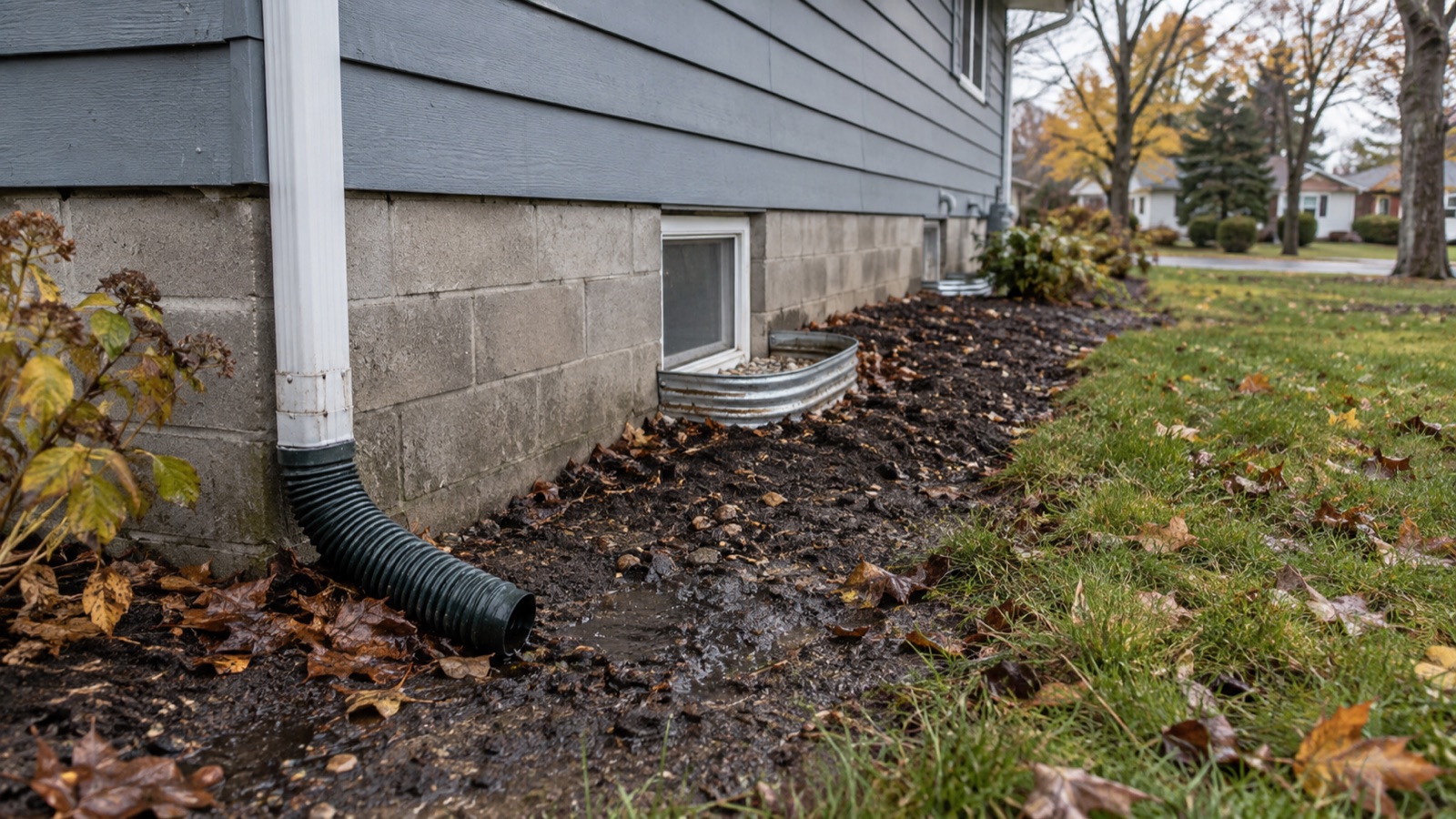
This is the first source to check. A short downspout, settled backfill, a low patio, or ground that slopes toward the house can concentrate rain and snowmelt against the basement wall. University of Minnesota Extension notes that a one-inch rain drops about 1,250 gallons on a 2,000-square-foot roof. Poor drainage can direct a meaningful share of that water to one or two corners.
Surface water usually shows a pattern. Moisture appears after heavy rain, near a downspout, below a window well, or along the wall where the grade is lowest. Corrective grading and properly extended downspouts may solve the problem before below-grade work is needed.
2. Seasonal groundwater or perched water
Groundwater can rise during wet periods, and water can also collect temporarily above a less permeable soil layer. That localized perched water may press against a foundation even when the regional aquifer is much deeper.
Signs include seepage at the wall-floor joint, dampness across a broad floor area, or a sump that runs long after the rain stops. A functional interior drain tile system can collect water beside and beneath the slab and route it to a sump pump before pressure forces it into the basement.
3. Water moving through masonry
Concrete block, mortar, and poured concrete are porous. Water can move through them by capillary action or follow a crack, joint, or pipe opening. White mineral deposits on a wall, called efflorescence, are evidence that moisture has passed through masonry and evaporated.
Efflorescence is a clue, not a diagnosis. It does not tell you whether the source was surface runoff, groundwater, or a one-time event. Our guide to why East Metro homes get wet basements explains how soil, backfill, and drainage work together around a foundation.
4. Indoor humidity and condensation
A basement can look wet even when no liquid water is entering through the foundation. Warm, humid summer air condenses on cool concrete, pipes, and floors. This often causes general dampness rather than a defined leak path.
The Minnesota Department of Health recommends looking for visible moisture, staining, standing water, and musty odors, then correcting the source. A dehumidifier can control humidity, but it cannot repair a failed drain tile system or stop runoff from reaching the wall.
How to read the pattern before choosing a repair
Document when and where the water appears. Take photos after rain, during spring thaw, and after several dry days. Check these conditions at the same time:
- Timing: Does water appear during rain, hours later, or during dry humid weather?
- Location: Is it at a wall crack, window well, wall-floor joint, or across the slab?
- Exterior drainage: Do gutters overflow, downspouts discharge close to the house, or low spots hold water?
- Sump behavior: Does the pump cycle normally, run continuously, or fail to start?
- Wall condition: Are there horizontal cracks, stair-step cracks, inward bowing, or damaged mortar?
- Moisture evidence: Are there stains, peeling finishes, efflorescence, mold, or a persistent musty odor?
These observations help separate a drainage problem from a structural one. They also prevent a common mistake: sealing the visible entry point while leaving water pressure in place behind it.
Match the repair to the source
There is no single waterproofing product for every White Bear Lake home. The sequence should follow the evidence.
- Control roof and surface water. Clean gutters, extend downspouts, correct low spots, and restore positive slope away from the house.
- Repair window well drainage. Clear debris, confirm the well drains, and keep runoff from entering at the rim.
- Test the sump system. Confirm the float activates the pump, the discharge line is open, and water exits away from the foundation.
- Relieve below-grade water pressure. When groundwater or persistent subsurface water is the source, repair or install an appropriate perimeter drainage system.
- Address structural damage. Stabilize bowed block, displaced cracks, or deteriorated masonry when movement accompanies the water problem.
Interior coatings and cosmetic patches can hide symptoms for a while, but they do not remove water from the soil or from beneath the slab. University of Minnesota Extension recommends correcting grading, gutters, and downspouts first, then using an interior or exterior drainage system if moisture persists.
Get a site-specific basement diagnosis
White Bear Lake’s hydrology is real, but a lake-area address does not prove the cause of one wet basement. Lot elevation, seasonal conditions, surface drainage, construction, and the condition of the drain tile and sump all matter.
Concrete & Foundation Solutions provides free inspections throughout White Bear Lake and the Twin Cities East Metro. If water keeps returning, the sump runs constantly, or moisture appears with foundation movement, call 651-364-4400 or request an inspection. We will trace the water path and recommend the repair that fits the source.
Sources
- Minnesota DNR, White Bear Lake groundwater management
- U.S. Geological Survey, groundwater and surface-water interactions near White Bear Lake
- U.S. Geological Survey, northeast Twin Cities lake levels and groundwater exchanges
- University of Minnesota Extension, moisture in basements
- Minnesota Department of Health, mold and moisture
Related Services
Have a Foundation Concern?
Get a free, honest inspection from a local team with 20+ years of Twin Cities experience.
Call 651-364-4400