
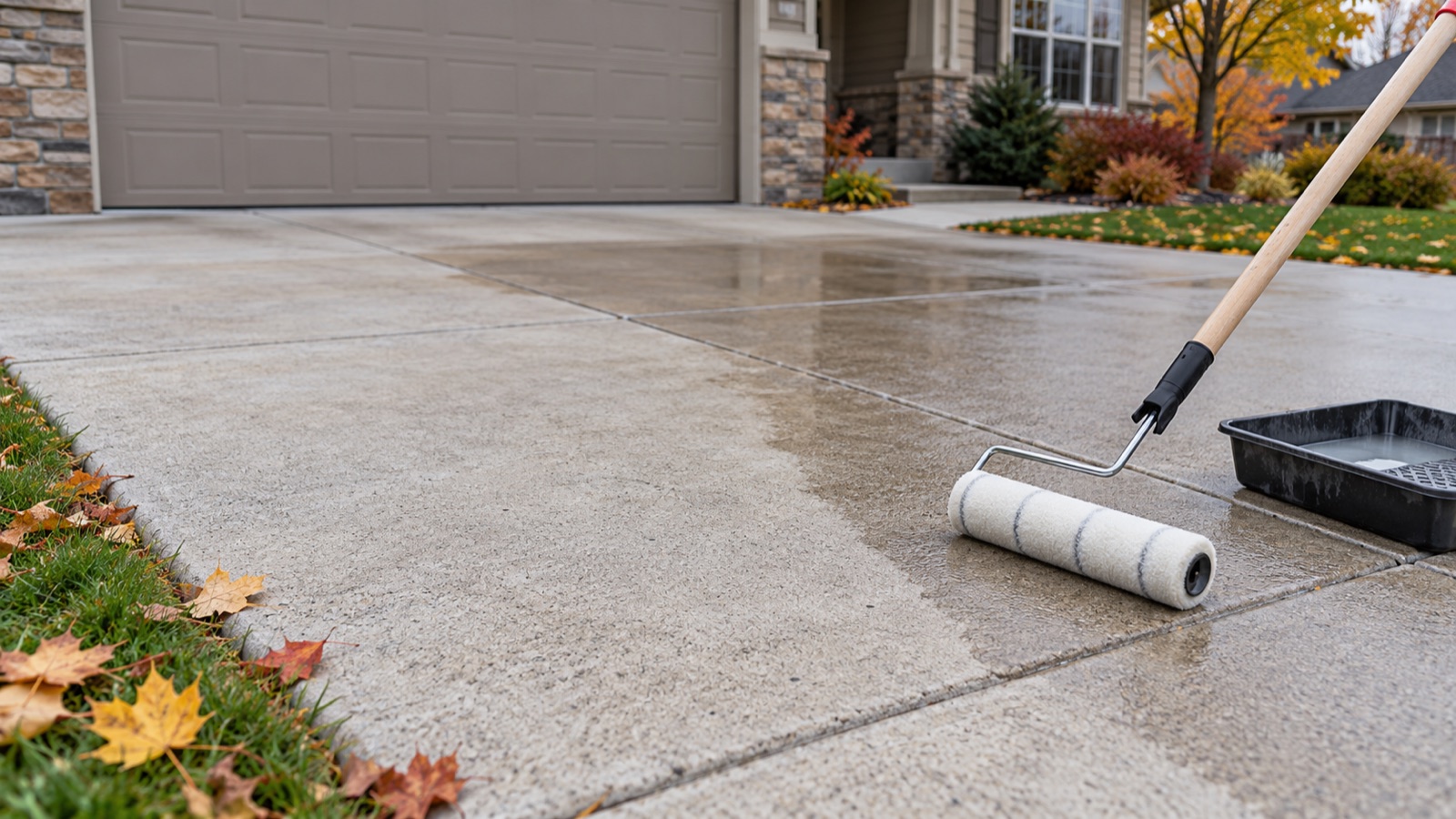
Quick answer: Minnesota concrete lasts longer when water can drain, joints stay clear, and changes are caught early. Sealer may reduce surface water entry on suitable concrete, but it will not repair scaling, settlement, or an active crack.
This guide is for Twin Cities homeowners deciding what to do with an exterior driveway, patio, walkway, or set of steps before winter. It focuses on routine observation and maintenance, not a visual diagnosis. Concrete age, mix, curing, prior coatings, drainage, and damage all affect the right next step.
The useful order is simple: drain, inspect, decide, protect, and monitor. Starting with a sealer purchase skips the most important question, which is whether the slab is sound and where the water goes.
Decision guide: On a small screen, scroll horizontally to see all columns.
| What you see | Practical next step | When maintenance is not enough |
|---|---|---|
| Water or slush sits on the slab or in joints | Clear debris and observe runoff during rain or melting | Ponding returns or a section has settled |
| Surface is sound, clean, and evenly textured | Check whether a compatible penetrating sealer fits the surface and product instructions | You cannot identify an existing coating |
| A narrow crack looks unchanged | Photograph and measure the same location each season | The crack widens, leaks, or develops vertical movement |
| Scaling or flaking is spreading | Keep loose material from hiding the condition | Deterioration is widespread, deep, or worsening |
| Steps or walks need winter traction | Remove snow early and use a surface-appropriate traction plan | Ice repeatedly forms because water drains across the walking surface |
Start With Water, Not the Sealer
Concrete contains pores. When the material becomes wet and then freezes, internal pressure can contribute to deterioration. Air entrainment in the original mix helps resist freeze-thaw damage, according to the American Concrete Institute’s technical guidance, but homeowners cannot add that protection after the slab has cured.
Maintenance begins with the water you can control. Sweep leaves, soil, and grit out of control joints. Keep downspouts from emptying onto a driveway or patio. Watch whether meltwater travels off the slab or settles against the garage, steps, or foundation.
A surface treatment addresses water entering from above. It does not correct a low spot, unstable base, or poor yard slope. If runoff moves toward the house, review the difference between surface maintenance and corrective grading before assuming a coating will solve it.
Inspect Concrete in Spring and Fall
Use the same short inspection twice a year, once after the spring thaw and once before regular fall freezing. Take photos from the same locations so you can compare change rather than rely on memory.
Look for:
- Ponding: water that remains after surrounding areas have drained.
- Joint condition: debris, vegetation, failed joint material, or edges that are breaking away.
- Surface change: scaling, pitting, popouts, or loose flakes.
- Crack movement: a crack that is wider, longer, wet, or uneven from one side to the other.
- Slab height: a section that has lifted or settled enough to hold water or create a trip edge.
MnDOT’s joint-sealing research overview explains that joints are sealed to limit water and incompressible material, and that preparation and installation affect performance. Residential flatwork is not a highway, but the maintenance principle transfers: dirty, wet, poorly prepared joints are not a sound base for a repair product.
Decide Whether Sealing Fits the Surface
Sealers have different jobs. Some penetrate the pore structure and repel water. Others form a film at the surface. The Federal Highway Administration’s overview of overlays and sealers describes this basic distinction and notes tradeoffs such as penetration depth, wear, and possible skid-resistance concerns with film-forming products.
For a Minnesota driveway or walkway, the label, existing finish, traction needs, weather window, and surface condition matter more than a universal product name. Before application:
- Identify any existing coating if possible.
- Remove dirt, residue, and loose material using a method appropriate to the concrete.
- Let the surface dry for the period required by the product.
- Confirm the forecast and concrete temperature fit the application instructions.
- Test an inconspicuous area for appearance and compatibility.
- Follow the listed coverage rate, cure time, ventilation, and safety requirements.
Do not seal over active flaking to make it look finished. The FHWA materials-distress guidance notes that surface sealers can reduce entry of water and chlorides from above, but moisture can still enter from the sides and bottom. Field results also vary with the existing condition. A sealer is one layer of maintenance, not a warranty against winter.
Handle Snow, Ice, and Deicers Carefully
Prompt snow removal reduces the amount of meltwater available to enter joints and low spots. Use tools that will not gouge the surface, and move piled snow where repeated melting will drain away from the slab and home.
Deicers add another variable. ACI explains that chloride-rich solutions can collect at joints and contribute to physical and chemical deterioration under repeated wetting, drying, and freezing conditions in its guidance on joint deterioration. That does not make one consumer product automatically safe for every driveway.
Follow the exact label, use only what conditions require, and avoid leaving concentrated slush in joints or depressions. Traction materials can improve footing without melting ice, but they still need to be swept up so they do not clog joints and drainage paths.
Know When Maintenance Is Not Enough
Cleaning and sealing are preventive steps for concrete that is still serviceable. They are not structural repairs. Request an evaluation when you see:
- widening cracks or water entering near the home,
- vertical displacement between slab sections,
- widespread scaling or deep spalling,
- recurring ponding after debris is cleared,
- movement that returns after seasonal patching, or
- deterioration at steps, garage edges, or foundation connections.
Our guide to Minnesota freeze-thaw effects on concrete explains the broader damage mechanism. If a driveway has already moved or broken down, the driveway repair-versus-replacement guide provides a more useful next decision than another coat of sealer.
Extended Recap and Seasonal Checklist
Good concrete maintenance is a condition-based process. In spring, document what changed during winter and note where water collects. In summer, clean joints, correct simple runoff problems, and decide whether the sound surface is suitable for a compatible sealer. In fall, clear debris, check cracks and edges, and plan where snow and meltwater will go. During winter, remove snow early and watch where ice repeatedly returns.
The decision rule is practical: protect sound concrete, investigate active damage, and fix water movement before covering the surface. A surface treatment belongs after that diagnosis, not before it. If routine care no longer matches the condition, the next useful step is an evaluation of the slab, drainage, and surrounding grade.
About the Author
Concrete & Foundation Solutions is a licensed Minnesota contractor based in Woodbury, serving the East Metro and St. Croix Valley. The company provides concrete installation, foundation repair, block repair, drainage, and grading services. Learn more about its concrete services and the local conditions those systems are designed to handle.
Related Articles
Related Services
Have a Foundation Concern?
Get a free, honest inspection from a local team with 20+ years of Twin Cities experience.
Call 651-364-4400