
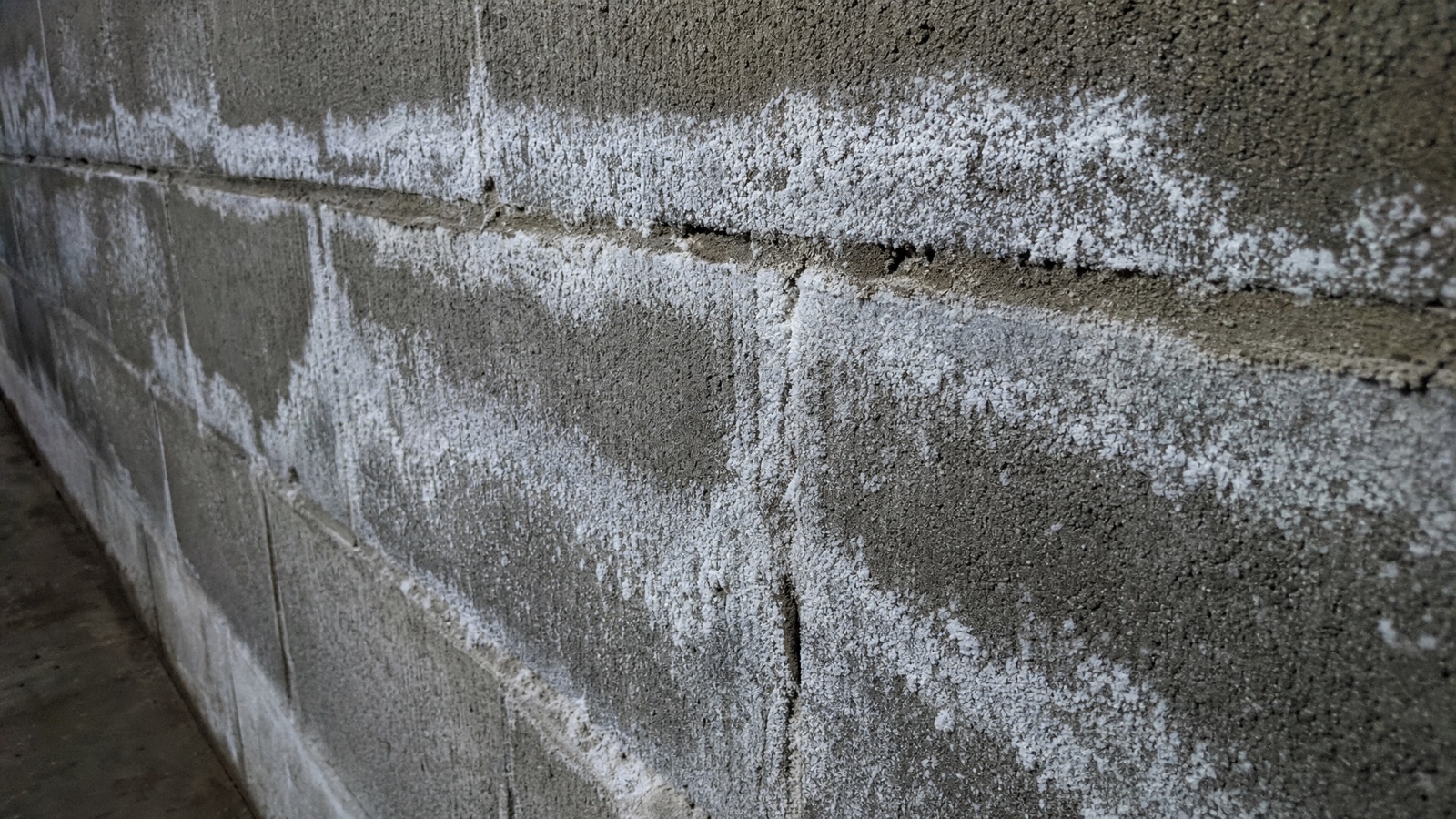
If you have noticed a chalky white film or crystal like crust spreading across your basement walls, you are looking at efflorescence. It is one of the most common things we get asked about in Woodbury, Stillwater, and across the East Metro, and most homeowners assume the worst. The good news is that the powder itself is harmless. The important news is that it is telling you something about water moving through your foundation, and that part is worth paying attention to.
What efflorescence actually is
Concrete, block, brick, and mortar all contain naturally occurring soluble salts. When water moves into and through these masonry materials, it dissolves those salts and carries them along. Once that water reaches the surface of the wall and evaporates into your basement air, the salts get left behind as a white, powdery, sometimes crystalline deposit. That deposit is efflorescence.
In other words, efflorescence is not a stain, a paint failure, or a living organism. It is mineral residue, the fingerprint left behind after water has traveled through your foundation and dried out. Wherever you see it, water has been there.
Why Minnesota basements are prone to it
The Twin Cities sit on dense glacial clay till, a heavy soil that holds moisture instead of draining it away. Clay can pull water upward through capillary action and stay saturated long after a storm has passed. That moist soil presses against your foundation and creates hydrostatic pressure, the force that drives water through any pore, hairline crack, or cove joint it can find.
Our climate makes it worse on a schedule. Minnesota’s frost depth runs around 42 inches, so the ground freezes well below most footings every winter. When spring snowmelt arrives, water cannot soak into ground that is still frozen a few feet down, so it travels sideways until it hits your foundation wall. The University of Minnesota Extension makes the point plainly: with basement moisture, the best approach is almost always to control the source of the water rather than fight it at the last line of defense.
This is exactly why so many East Metro homes get wet basements in the first place. Efflorescence is one of the earliest and most visible symptoms of that pattern.
Efflorescence versus mold: how to tell the difference
This is the question that worries homeowners most, and it is easy to sort out yourself with a simple test.
- The water test. Spray or dab a little water onto the white substance. Efflorescence is a salt and will dissolve and vanish. Mold is a fungus and will not be affected.
- Texture. Efflorescence feels gritty, chalky, or crystalline and brushes off as a dry powder. Mold tends to look fuzzy or cotton like and clings to the surface.
- Location. Efflorescence appears only on masonry surfaces such as poured concrete, block, brick, and mortar. Mold can grow on wood, drywall, carpet, and other organic materials.
- Color and smell. Efflorescence is white, sometimes off white or tan, and has no odor at all. Mold can be almost any color and usually brings a musty smell.
If the deposit dissolves with water, sits on bare concrete or block, and does not smell, you are dealing with efflorescence rather than mold. That distinction matters, because the moisture that creates efflorescence is also the moisture that eventually feeds mold on nearby wood and drywall.
Why the white powder is a warning worth heeding
By itself, efflorescence will not hurt your home or your family. The problem is what it confirms: liquid water is passing through your foundation wall. That moisture is the same force behind a long list of more serious issues, including cracking, bowing or bulging walls, rotted framing, ruined finishes, and the conditions mold needs to take hold.
Think of efflorescence as a quiet early warning. It often shows up before you ever see standing water on the floor. Watch for it alongside other signals such as damp or stained walls, a persistent musty odor, peeling paint, and any visible cracks. When several of these appear together, the foundation is actively taking on water and the issue tends to worsen with each spring thaw and heavy rain.
How to fix it for good
Most homeowners reach for a brush first, and you can certainly clean the surface. A stiff brush with water, white vinegar, or a masonry cleaner made for efflorescence will lift the deposit. Save stronger acids for a true last resort, and never seal or paint over a wall while it is still actively pushing salts out, because trapped moisture has to go somewhere.
The part that matters is that cleaning is purely cosmetic. As long as water keeps moving through the wall, the powder returns. A lasting fix means stopping the water at its source, and that usually involves one or more of the following:
- Manage surface water first. Extend downspouts well away from the house and correct the slope of your yard. Corrective grading keeps rain and snowmelt from collecting against the foundation, which is the cheapest and most effective first move on many homes.
- Relieve hydrostatic pressure below grade. When groundwater is the culprit, an interior or exterior drain tile system paired with a working sump pump collects water and routes it out before it can press through the wall. Our breakdown of interior drain tile for wet basements explains how that system works.
- Repair and seal the wall. Cracks, deteriorated mortar joints, and damaged block all give water an easy path. Targeted foundation repair closes those openings as part of a complete waterproofing plan.
The right combination depends on your soil, your grade, the age of the home, and how much water is actually moving. That is something best confirmed in person rather than guessed at.
Get a straight answer with a free inspection
Efflorescence is your foundation telling you it is letting water in. The smart response is not panic, and it is not paint. It is a clear diagnosis of where the water is coming from and a plan to stop it.
Concrete & Foundation Solutions has spent more than 20 years diagnosing and waterproofing basements across the Twin Cities East Metro and St. Croix Valley, from Woodbury and Oakdale to Stillwater, Cottage Grove, and Hudson. If white powder keeps showing up on your walls, call 651-364-4400 or request a free inspection. We will tell you exactly what is happening behind that wall and give you an honest plan, with no pressure.
Related Services
Have a Foundation Concern?
Get a free, honest inspection from a local team with 20+ years of Twin Cities experience.
Call 651-364-4400