
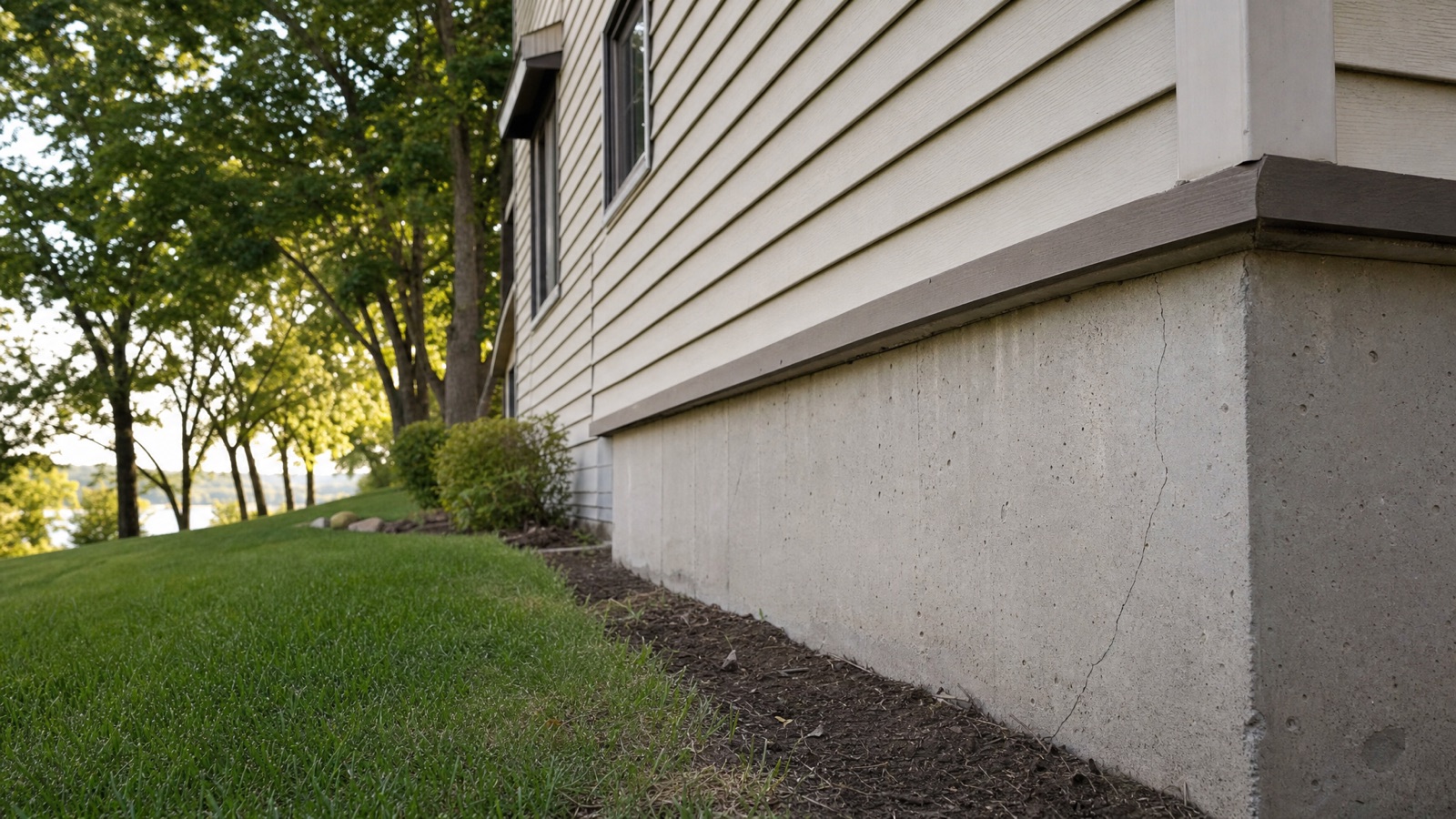
If you own a home in Cottage Grove, your foundation is dealing with a tougher set of conditions than most people realize. The city sits on the north bank of the Mississippi River, with more river-adjacent land than any other city in Minnesota, and that location brings bluffs, ravines, clay pockets, and pockets of loose glacial sand all within the same neighborhoods. Add Minnesota’s brutal freeze-thaw swings and the fact that a large share of local homes were built decades ago, and foundation issues across Cottage Grove are common. The good news is that nearly all of them are fixable when you catch them early.
Why Cottage Grove soil is hard on foundations
Foundation trouble almost always starts with the ground, and Cottage Grove has a complicated mix of it. The terrain reflects the upper Mississippi River valley, with elevations running from roughly 670 feet near the water up past 900 feet on the bluff tops. Underneath your yard you may find glacial till, alluvial river deposits, clay layers, or the sandy outwash that forms the dune-like ground in the Mississippi Dunes area on the south end of town.
Each of those soils behaves differently, and that is the problem:
- Clay pockets absorb water and swell, then dry out and shrink. That constant expansion and contraction pushes on basement walls and lifts and drops footings.
- Glacial till is dense and generally stable, but it holds water and heaves when it freezes.
- Sandy outwash drains fast, which is good, but loose or poorly compacted fill can wash out and let a footing settle.
When a single lot sits on more than one of these, different parts of the foundation move at different rates. That uneven movement is what cracks walls and settles corners.
The freeze-thaw factor
Minnesota’s frost line reaches about 42 inches deep, among the deepest in the country, which is why local footings are required to sit well below grade. The freeze-thaw cycle typically starts in October and does not fully release until May, so your foundation spends roughly eight months a year under seasonal stress.
Here is what that looks like in a Cottage Grove basement. Water in the soil freezes and expands, pressing inward on the walls and upward under slabs and footings. Then it thaws, the soil softens, and everything settles back, rarely to exactly where it started. Repeat that for thirty or forty winters and you get the foundation cracks and movement we see across the East Metro. Grading that lets meltwater pool against the house makes it dramatically worse, because saturated soil freezes harder and heaves more.
Common foundation problems in Cottage Grove homes
Cottage Grove grew fast during the postwar suburban boom, jumping from a few hundred residents in 1950 to more than 13,000 by 1970, and the housing stock reflects it. Neighborhoods like Thompson Grove brought ranch-style homes early, the 1970s and 1980s added split-levels and two-story houses, and newer areas like East Ridge and Prestwick filled in later. That range of build eras means we see a full range of problems.
Wall cracks and bowing
Poured concrete and concrete block foundations both crack under soil pressure. Thin vertical cracks are usually cosmetic, but horizontal cracks and stair-step cracks in block walls signal that soil is pushing the wall inward. Left alone, a wall can start to bow. Understanding which foundation cracks are serious is the first step to knowing whether you need a repair or just a watchful eye.
Settling and sinking
When soil compresses or washes out under a footing, that section of the house drops. You see it as sticking doors, cracks above windows, sloped floors, and gaps opening between the wall and the ceiling or trim. Older homes on the bluffs and near the ravines are especially prone to this because water movement through sloped ground carries fine soil away over time.
Wet and leaking basements
This is the most common call we get in Cottage Grove. Water finds its way in through wall cracks, through the joint where the wall meets the floor, and up through the slab when the water table rises. Homes downslope from higher ground, or with grading that tilts toward the foundation, take the worst of it. If you want the full picture, we broke down why East Metro homes get wet basements in a separate guide.
How these problems get fixed
The right repair always matches the cause, which is exactly why we inspect before we quote. Here is how the common fixes work.
- Crack repair. Non-structural cracks get sealed with polyurethane or epoxy injection that fills the full depth of the wall and keeps water out.
- Wall stabilization. Bowing or cracked walls are reinforced with carbon fiber straps or steel bracing, and in serious cases pulled back toward plumb with wall anchors.
- Piering and underpinning. A settled section is lifted and permanently supported on piers driven down to stable soil or bedrock, so it stops moving.
- Drainage and waterproofing. Interior drain tile, a good sump system, and corrective grading that carries water away from the house address the moisture that caused the damage in the first place.
That last point matters most. Structural repairs fix the symptom, but if you do not control the water and the soil moisture around your Cottage Grove home, the pressure comes right back. A complete fix almost always pairs a structural repair with drainage improvements.
Get a straight answer from a local team
Foundation problems do not fix themselves, and they rarely get cheaper by waiting. If you have noticed cracks, a door that will not latch, a musty or damp basement, or floors that feel off, the smart move is to have it checked before another freeze-thaw season works on it.
Concrete & Foundation Solutions is a Woodbury-based, MN-licensed team with more than 20 years of experience repairing foundations across Cottage Grove and the East Metro. We give honest assessments, written estimates, and quality foundation repair that lasts. Call 651-364-4400 or contact us for a free inspection, and ask about financing if you would rather spread the investment out.
Related Services
Have a Foundation Concern?
Get a free, honest inspection from a local team with 20+ years of Twin Cities experience.
Call 651-364-4400