
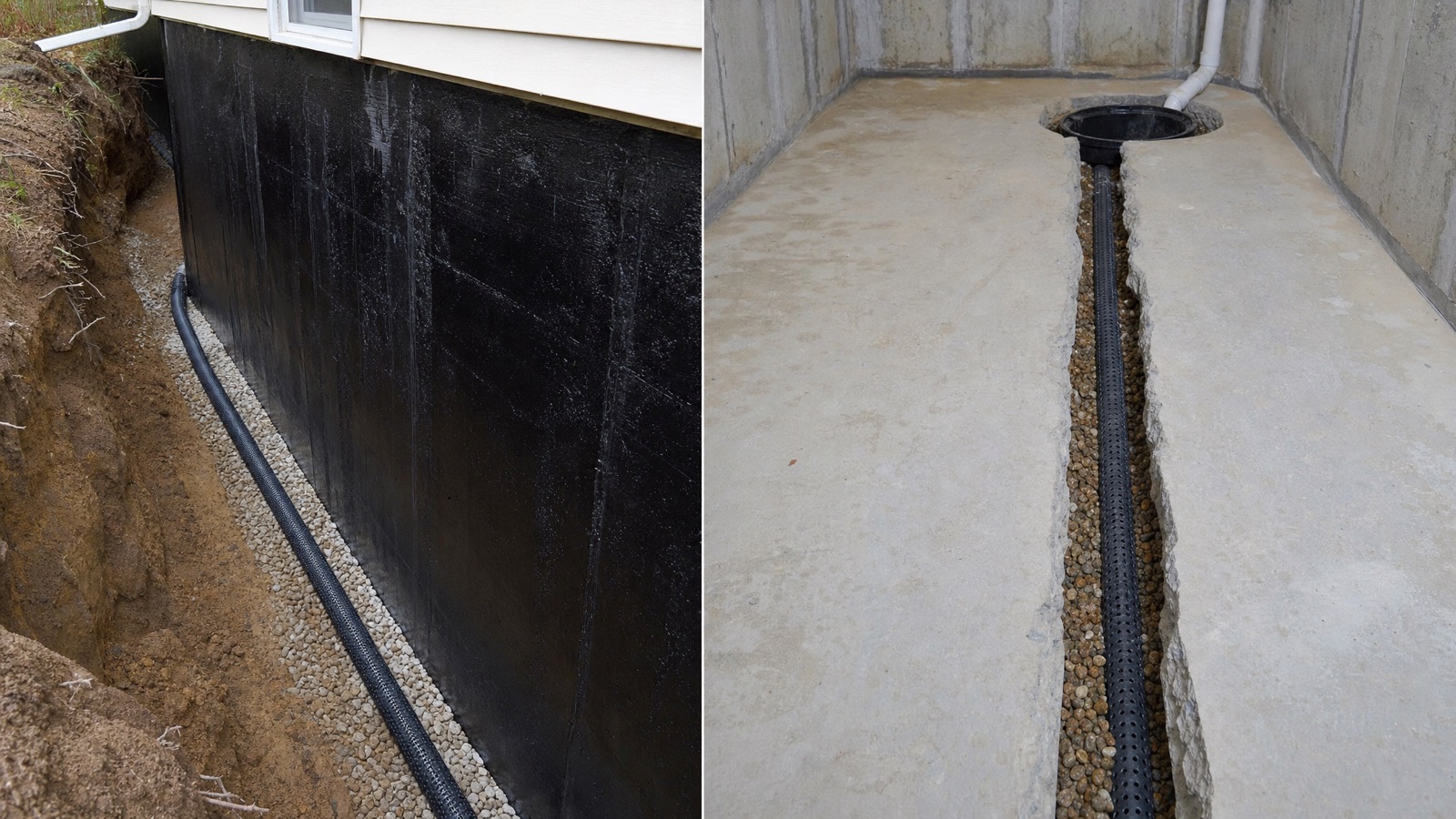
If your Twin Cities basement leaks, you have probably run into two very different sales pitches. One contractor wants to dig up the inside perimeter of your floor. Another wants to excavate the entire outside of your foundation down to the footings. Both can produce a dry basement. They are not the same job, they do not cost the same, and they are not right for the same situations.
This guide explains how interior and exterior waterproofing actually work, what each one costs you in money and disruption, and how to think about the choice given the clay soil and deep frost we deal with here in the East Metro and St. Croix Valley.
Why Minnesota Basements Take On Water
Before comparing methods, it helps to understand what you are fighting. Most basement water problems in the Twin Cities trace back to the same combination of conditions.
Our dominant soil is glacial clay till, a dense material left behind by ancient ice sheets. Clay holds water rather than letting it drain, and when it saturates it swells and presses against your foundation. That force is called hydrostatic pressure, and it is what drives water through the smallest crack or through the cove joint where your floor meets the wall.
Then there is frost. Minnesota has one of the deepest frost depths in the country, on the order of 42 inches in many areas, so the ground freezes solid well below typical footings. Every spring that frost releases a large volume of meltwater that has to go somewhere, and a lot of it moves straight toward saturated soil against your foundation. This is a big part of why so many East Metro homes get wet basements.
Both waterproofing approaches are really just two different answers to the same question: what do we do with all that water?
Interior Waterproofing: Manage the Water Inside
Interior waterproofing, most often an interior drain tile system, does not try to keep water out of the foundation wall. It assumes water will arrive and gives it a controlled path out.
Here is how the system works:
- A narrow strip of the basement floor, usually 12 to 18 inches wide, is cut and removed around the interior perimeter down to the footing.
- A perforated pipe is laid in a bed of clean washed gravel along that trench.
- The pipe carries collected groundwater to a sump pit.
- A sump pump senses the rising water and discharges it outside, away from the foundation.
The whole assembly relieves hydrostatic pressure at the most vulnerable point, the cove joint, and sends the water out before it can pool on your floor. You can read more about this in our dedicated post on interior drain tile for wet basements.
The advantages of interior systems:
- Lower cost and far less disruption. No excavation outside means no torn-up landscaping, driveway, or deck.
- Fast installation. Many systems go in within a day or two.
- It works through winter. The system runs regardless of frozen ground outside.
- Accessible for maintenance. The pipe sits on top of the footing where it can be serviced, and these systems usually come with a transferable warranty.
The trade-offs:
- It does not seal the wall. Water still reaches the foundation; the system just removes it.
- It depends on a pump. A sump pump is a mechanical part that typically lasts about 7 to 10 years and needs a battery backup to survive the power outages that come with the same storms that flood basements. Our sump pump guide for Minnesota basements covers how to keep that component reliable.
- A finished basement adds cost. If the lower level is finished, the wall coverings along the perimeter have to come off and go back on.
Exterior Waterproofing: Keep the Water Out
Exterior waterproofing attacks the problem at the source. Instead of managing water inside, it seals the outside of the wall so the water never gets in.
A full exterior job involves excavating the soil around the foundation down to the footings, cleaning the wall, and applying a waterproof membrane or coating. A drainage board and a new exterior drain tile line are usually added at the footing to carry water away. Quality exterior membranes are rated to last decades, often in the 25 to 50 year range depending on the product.
The advantages of exterior systems:
- It stops water at the wall. The foundation surface stays dry, which protects the wall itself, not just your floor.
- It relieves pressure outside. Intercepting groundwater before it reaches the wall reduces the lateral load that bows and cracks foundations over time.
- No interior demolition. For a finished basement, the work happens entirely outside.
- Long service life. A properly installed membrane can protect the wall for decades with little attention.
The trade-offs:
- Higher cost. Excavation is labor and equipment heavy, so exterior work commonly runs roughly double an interior system or more.
- Significant disruption. Digging around the house can mean removing landscaping, walkways, decks, or sections of driveway, and putting them back.
- Harder to access later. If something needs attention down the road, reaching it means excavating again.
How to Choose for Your Home
There is no single right answer, only the right answer for your situation. A few honest rules of thumb:
- Existing home, active leak, sound structure. An interior system usually delivers the same dry basement at a fraction of the cost and mess. This is the most common scenario we see in Woodbury, Cottage Grove, Oakdale, and the surrounding East Metro.
- The wall is already exposed, or it needs structural repair. If we are excavating anyway to address a foundation repair issue like a bowing or cracked wall, adding exterior membrane at the same time is efficient and sensible.
- New construction or a major addition. Exterior waterproofing during the build is the cheapest it will ever be.
- Surface water is part of the problem. Sometimes the real fix is neither method but corrective grading and better downspout drainage to keep water away from the foundation in the first place. We will tell you if that is the case rather than sell you a system you do not need.
In a lot of homes the best outcome is a combination: relieve the water that is already getting in with an interior system, and correct the grading and drainage outside so less water arrives at the wall to begin with.
Get an Honest Assessment First
The waterproofing method matters less than the diagnosis behind it. The wrong fix, even installed well, leaves you wet and out of pocket. Before you commit to anyone digging anything, get a clear read on where the water is coming from and what your foundation actually needs.
Concrete & Foundation Solutions has worked on Twin Cities basements for more than 20 years, across the East Metro and the St. Croix Valley. We offer free inspections and a straightforward recommendation, interior, exterior, or drainage correction, based on what we find at your home, not on what is easiest to sell.
Call us at 651-364-4400 or contact us to schedule your free inspection. We will look at the walls, the floor, the grading, and the drainage, and tell you exactly what is going on and what it will take to keep your basement dry.
Related Services
Have a Foundation Concern?
Get a free, honest inspection from a local team with 20+ years of Twin Cities experience.
Call 651-364-4400