
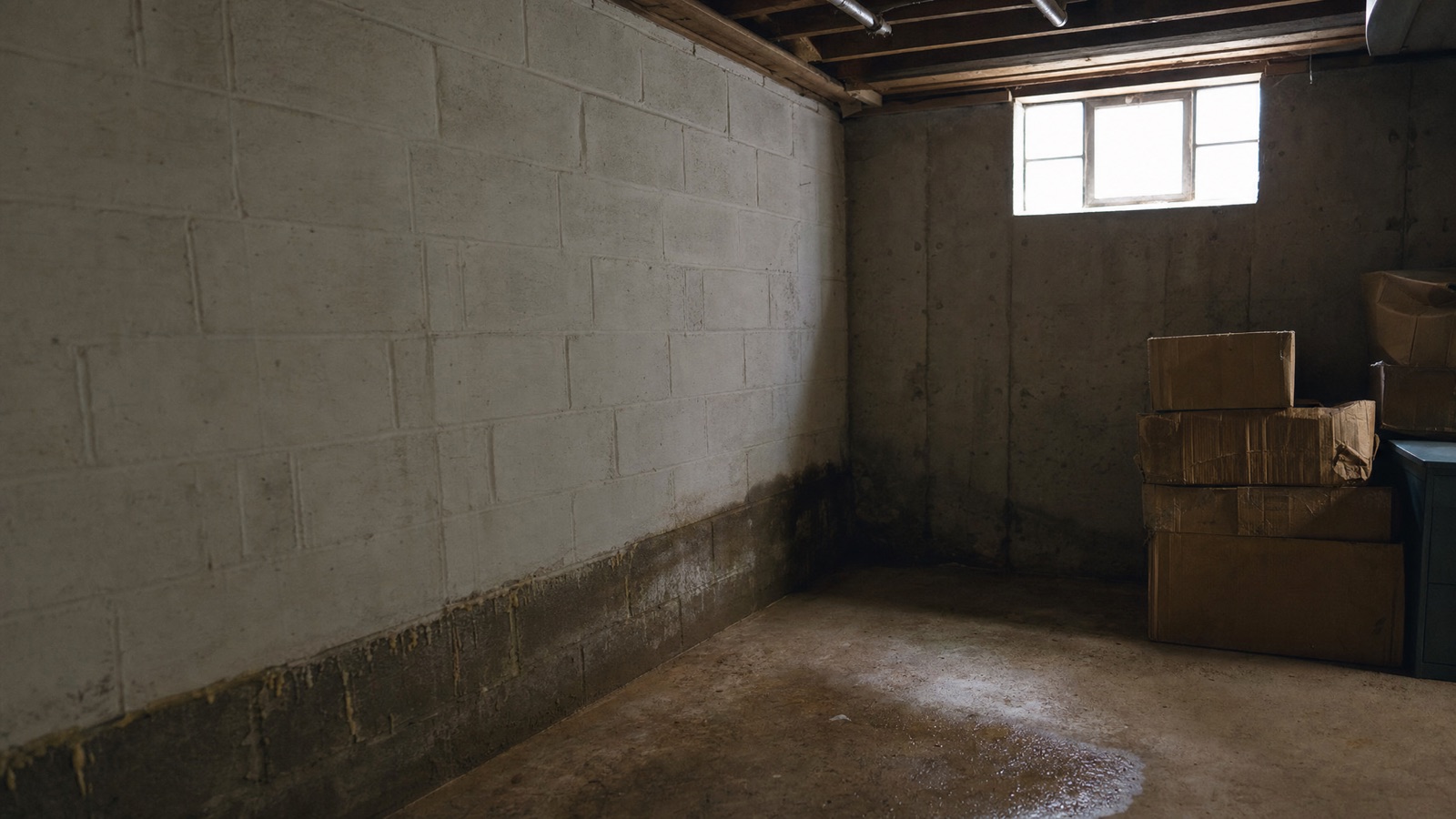
You walk down the basement stairs and it hits you. That heavy, earthy, slightly sour smell that no candle or plug-in ever really covers. Most Twin Cities homeowners treat it as a normal part of owning an older house. It is not. A musty basement is your home telling you it has a moisture problem, and in the East Metro that usually traces back to something specific and fixable.
What That Smell Actually Is
The musty odor is not the moisture itself. It is a byproduct of mold and mildew that are actively growing somewhere down there, and the smell means the colony is already established rather than just getting started.
Mold cannot grow without water. That is the whole story, and it is also the good news, because it means you do not have a mold problem so much as a water problem with a mold symptom. The Minnesota Department of Health takes this same position. It generally does not recommend testing for mold. It recommends finding where the moisture is coming from and cutting it off.
The EPA target for indoor relative humidity is 30 to 50 percent, and never above 60. Once relative humidity holds above 60 percent, mold can take hold on organic material, and basements are full of organic material: cardboard boxes, framing lumber, paper facing on fiberglass batts, drywall, carpet pad, stored clothing.
Why East Metro Basements Get Damp in July
Here is the part that confuses people. The basement smells worst in the middle of a hot, dry stretch of summer, when there has not been rain in two weeks. That seems backwards until you understand dew point.
Your basement walls are surrounded by soil that stays cool year round, well below the temperature of the air upstairs. On a humid July afternoon in Woodbury, outdoor air might be 88 degrees at 55 percent relative humidity. Open a basement window or door and that air comes downstairs, hits cold concrete and cold water pipes, and cools fast. The moisture content has not changed, but the cooled air can no longer hold it. Relative humidity spikes well past 60 percent, and water condenses on every cold surface it touches.
This is why the old advice to open basement windows to air it out often makes things worse. In a Minnesota summer, you are pumping moisture in, not out.
Signs you are dealing with humidity and condensation rather than a leak:
- Beads of water on cold water pipes, the sump pit, and the outside of the foundation wall
- Damp, limp cardboard boxes that never fully dry out
- Rust appearing on tools, appliance legs, and the furnace cabinet
- The smell gets noticeably worse in July and August and better in January
Why East Metro Basements Get Damp After Rain
The other pattern is the one most people expect: the smell is worse for a few days after every heavy rain or during spring thaw. That is groundwater, and the diagnosis is different.
Woodbury, Cottage Grove, Oakdale, and Maplewood sit on heavy glacial till with a lot of clay content. Clay does not drain quickly. When a few inches of rain land on a lot that slopes even slightly toward the house, that water saturates the backfill soil against the foundation, which is looser than the undisturbed soil around it, and it sits there under pressure. Water follows the path of least resistance, which is the cold joint where the basement floor meets the wall, a hairline crack in a poured wall, or the mortar joints in a block wall.
Signs you are dealing with a water intrusion problem:
- Dark staining or a visible water line low on the wall
- White chalky efflorescence on block or concrete, which is mineral left behind by water passing through
- Water at the floor and wall joint specifically, or standing water after a storm
- A sump pump that runs constantly for days after rain, or one that never runs at all when it should
The Fixes, In Order of What Actually Works
Chasing the smell with bleach and air fresheners is the most common mistake we see. Here is the order that solves it.
1. Fix the water outside first
Most wet East Metro basements are made wet by things happening within ten feet of the house. Downspouts that dump at the foundation. Grading that has settled over twenty years until the yard now slopes toward the house instead of away from it. Window wells packed with clay and leaf litter instead of drainage rock.
The general standard is roughly six inches of fall over the first ten feet away from the foundation, plus downspout extensions that carry roof water well past that. Corrective grading is by a wide margin the cheapest fix on this list, and on a lot of homes it is the only one needed. Our full breakdown is in corrective grading as your first line of defense.
2. Address the water that still gets in
If water is still finding the floor and wall joint after the exterior is corrected, the answer is a drainage system rather than a coating. Interior drain tile collects water at the footing before it reaches the floor and routes it to a sump basket, where the pump moves it outside and away from the house.
Existing drain tile in a 1970s or 1980s home may be silted in, crushed, or clogged with iron ochre, in which case it is doing nothing at all. Sealant paints applied to the inside of a wall do not stop hydrostatic pressure. They hide the stain and trap moisture in the wall.
3. Repair cracks and failing block
Cracks in a poured wall and deteriorated mortar joints in a block wall are both direct paths for water and soil gas. Structural foundation repair closes those paths properly rather than caulking them shut from the inside.
4. Then, and only then, dehumidify
Once the water source is handled, a properly sized dehumidifier draining to the sump or a floor drain will hold the basement in the 45 to 50 percent range through a Minnesota summer. Run it as maintenance, not as treatment. If your dehumidifier is filling its reservoir every day, you still have a source problem.
5. Remove what is already growing
Wet cardboard, soaked carpet pad, and moldy paper-faced insulation cannot be dried out and saved. They come out. Hard surfaces like concrete and block can be cleaned once they are dry and staying dry.
One More Reason Not to Ignore It
The same cracks, floor and wall joints, and unsealed sump pit that let water and musty air in also let radon in. The Minnesota Department of Health reports that more than two in five Minnesota homes have radon at levels that pose a significant health risk, well above the national average. Sealing those openings properly is part of doing the repair right, not an upsell.
Get the Source Diagnosed
A musty basement is solvable, and it is usually solvable for less than homeowners expect once the actual source is identified. Guessing is what gets expensive.
Concrete & Foundation Solutions has been diagnosing wet basements across Woodbury, Stillwater, Cottage Grove, Oakdale, and the St. Croix Valley for more than 20 years. Call 651-364-4400 for a free inspection, or reach out through our contact page. We will tell you where the water is coming in, what it will take to stop it, and what it does not need.
Related Services
Have a Foundation Concern?
Get a free, honest inspection from a local team with 20+ years of Twin Cities experience.
Call 651-364-4400