
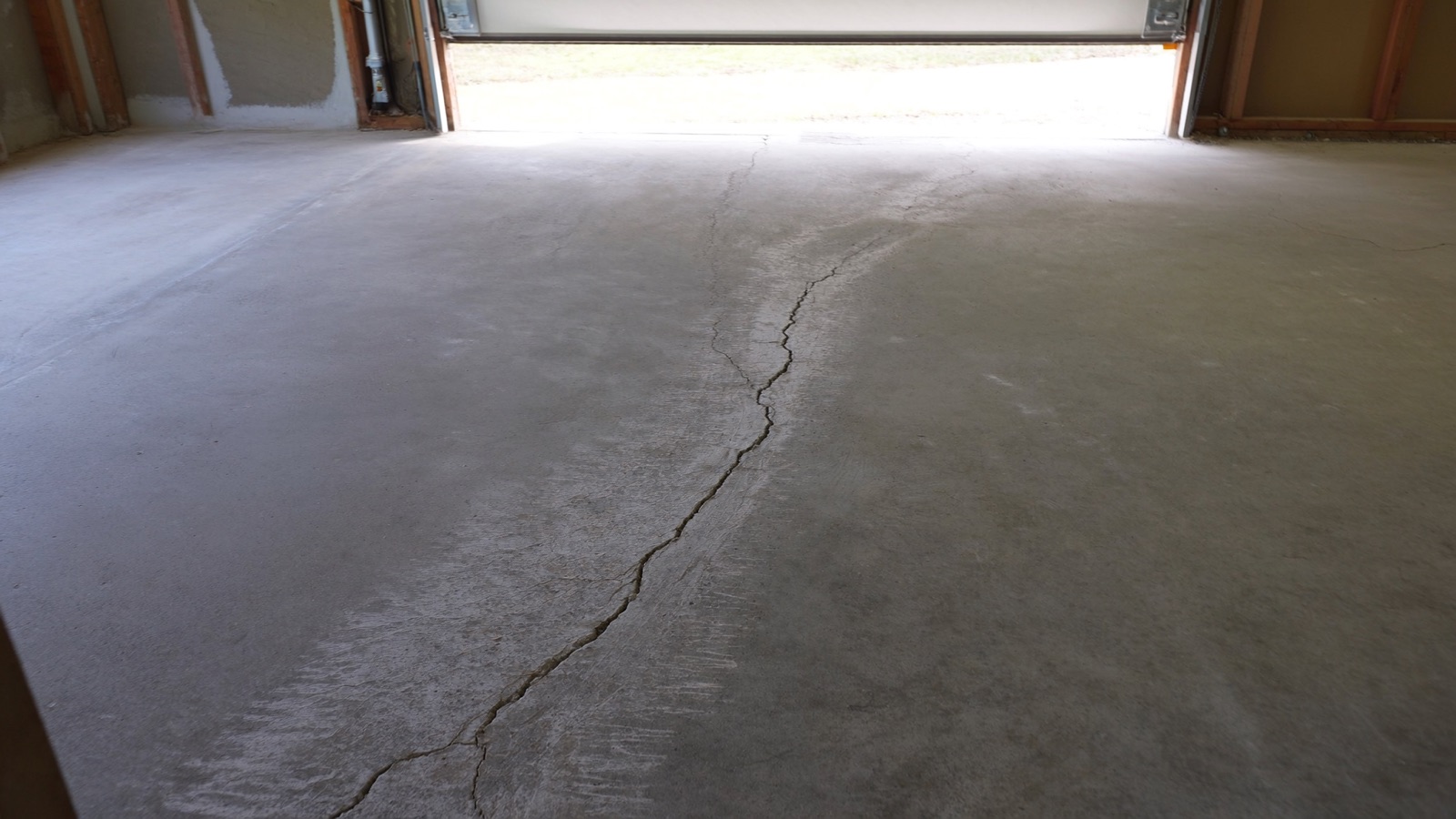
Quick answer: A garage floor crack is not automatically a foundation failure. Stable shrinkage cracks may need only monitoring or sealing. Cracks with vertical offset, widening, moisture, spalling, or repeated seasonal movement need the slab support and drainage evaluated before repair.
This guide is for Minnesota homeowners deciding whether a cracked garage slab is a cosmetic issue, a durability problem, or evidence of movement below the concrete. A photo and a tape measure can document the condition, but they cannot reveal the base material, drainage path, or full crack depth.
The useful question is not simply, “How wide is the crack?” It is, “What caused it, is it still moving, and what must the repair accomplish?” The American Concrete Institute notes that concrete cracks range from appearance-only conditions to signs of significant distress, so the surrounding evidence matters. See ACI’s guidance on evaluating cracked concrete.
Garage slab decision guide: On a small screen, scroll horizontally to see all columns.
| What you see | What it may indicate | Useful next step |
|---|---|---|
| Tight crack, level edges, no change | Stable shrinkage or restrained movement | Document, monitor, then consider sealing |
| Crack follows a sawed joint | The joint may be directing shrinkage as intended | Keep the joint functional and watch the edges |
| One side is higher, rocks, or changes seasonally | Base settlement, frost movement, or a void | Evaluate support and water before filling |
| Flaking, pitting, or broken edges | Surface deterioration plus water or salt exposure | Map all unsound concrete before patching |
First Decide Whether the Crack Is Stable
A stable crack has stopped changing enough for the selected repair to work. A moving crack can reopen through a rigid filler because the repair did not remove the movement.
Document the same locations with dated photographs. Place a ruler beside the crack for scale, but do not reduce the decision to one width. Note whether the edges remain level, whether water appears after snowmelt or rain, and whether the crack changes between winter and summer. Also look for related clues:
- Vertical offset that creates a tire or walking edge
- Branching or widening since the previous season
- Hollow or rocking sections near the crack
- Spalling or scaling that exposes loose aggregate
- Movement beyond the slab, such as a crack continuing into a wall
The crack pattern can narrow the possibilities, but an isolated visual sign is not a diagnosis.
Why Minnesota Garage Slabs Crack
Concrete shrinks as it dries. When the slab cannot move freely, tensile stress can create a crack. Contraction joints are intended to encourage shrinkage cracking at planned locations rather than across a random path. The ACI guide to slab-on-ground joints explains the different roles of contraction, construction, and isolation joints.
The support below the slab also matters. Poorly compacted fill, soil loss, an inadequate base, concentrated vehicle loads, or water moving through the base can allow one section to settle. In Minnesota, wet soil that freezes near a shallow or exposed slab can add seasonal movement. Our guide to frost heave around Minnesota homes explains why moisture and freezing conditions must be considered together.
Garage construction is not identical in every home. Minnesota DLI says attached-garage footings extend to frost depth, while qualifying detached garages may use a designed floating slab on suitable soil. See the state’s garage code summary. That distinction is one reason a garage-floor crack should not automatically be labeled a house-foundation failure.
Water, road salt, and repeated freezing can also turn a small opening or weak surface into a durability problem. ACI lists freezing, thawing, construction shrinkage, settlement, joint spacing, and load imbalance among possible crack causes. The local exposure side is covered in our Minnesota freeze-thaw concrete guide.
Match the Repair to the Cause
Monitoring is reasonable when the crack is tight, dry, level, and unchanged. This is an evidence-gathering step, not proof that the crack will never move.
Routing and flexible sealing may fit a crack expected to open and close. The groove and sealant create a movement-capable joint. It does not level a displaced slab or rebuild the base.
Gravity-fed resin may fill and bond a clean, dry, stable horizontal crack. ACI’s RAP-2 repair bulletin says the method is intended for nonmoving cracks and is not effective as a flexible repair for active movement. Oil, grease, dirt, existing coatings, and moisture can also interfere with penetration and bond.
Partial-depth patching can replace isolated unsound surface concrete after the damaged material is removed and the repair area is prepared. Covering loose or salt-damaged concrete without reaching sound material creates a weak boundary. The Federal Highway Administration’s concrete repair process starts with determining the cause and extent, then removing unsound concrete before applying and curing the selected material.
Full-depth removal and replacement may be more durable when cracking is widespread, multiple sections have vertical displacement, the slab support has failed, or surface deterioration covers much of a panel. Drainage or base problems should be corrected as part of the plan, or new concrete may inherit the same stress.
A Practical Inspection Sequence
- Clear and photograph the floor. Record the whole crack, nearby joints, the garage door threshold, and the wall edges.
- Check level and change. Look for vertical displacement and compare dated photos through a season.
- Trace water. Note snowmelt from vehicles, exterior runoff, downspouts, and ponding near the garage perimeter.
- Map the damaged area. Separate one stable crack from a panel with scaling, hollow sections, and several connected cracks.
- Define the repair objective. Decide whether the goal is monitoring, keeping water and salts out, restoring a surface, correcting support, or replacing a failed panel.
This sequence prevents a surface product from being chosen before the problem is defined. For protecting otherwise sound concrete after the cause is addressed, review our concrete sealing and winter maintenance guide.
Extended Recap: Diagnose Before You Fill
Garage floor cracks can come from ordinary shrinkage, joint behavior, settlement, frost movement, lost support, loading, or surface deterioration. A stable level crack is a different problem from a slab edge that rises each winter or a panel that rocks under a vehicle. Width is only one observation. Change over time, vertical offset, moisture, spalling, surrounding joints, and movement beyond the slab provide the useful context.
The repair should address both the cause and the objective. A stable crack may be monitored or sealed. A moving crack may need a flexible detail. Unsound surface concrete requires removal before patching. Failed support or widespread displaced cracking can make replacement the more honest option. Concrete & Foundation Solutions evaluates garage slabs and concrete conditions across the Twin Cities East Metro and St. Croix Valley. For a free on-site inspection, call 651-364-4400 or request an inspection.
About the Author
Concrete & Foundation Solutions is based in Woodbury and serves the Twin Cities East Metro and St. Croix Valley. The company evaluates concrete slabs, foundations, drainage, and site conditions, then recommends work based on the cause and extent of the damage found at the property.
Related Articles
Related Services
Have a Foundation Concern?
Get a free, honest inspection from a local team with 20+ years of Twin Cities experience.
Call 651-364-4400